


Protecting the City of Milwaukee for the Next Generation
Historic ships demand constant vigilance. As vessels age, the risks associated with hull deterioration increase exponentially, and museum ships across the Great Lakes have learned this lesson the hard way. In recent years, several historic vessels have experienced serious hull failures, with some now relying on continuous pumping to remain afloat.
The City of Milwaukee is no exception to the realities of time, water, and steel. While the ship remains stable today, we have experienced firsthand how quickly a minor issue can escalate. Several years ago, a frozen grease fitting on a sea chest in the City of Milwaukee’s engine room failed, allowing lake water to enter. Thankfully, the issue was identified and stopped quickly, before serious flooding occurred.
With ships, hull failures rarely provide advance warning. By the time a problem becomes visible, damage is often already extensive. Proactive preservation is the only responsible path forward.

Our Solution: A Planned Trip to Drydock
To ensure the long-term safety and preservation of the City of Milwaukee, we are pursuing a full drydocking project at Fincantieri Bay Shipbuilding in Sturgeon Bay, Wisconsin.
This project would include:
-
Tug transport to Sturgeon Bay
-
Blocking and removing the vessel from the water
-
Power washing and sandblasting the underwater hull
-
Sealing all sea chests and underwater openings
-
Applying two coats of high-performance, 25+ year marine epoxy coating
-
Completing additional steel repairs and maintenance as funding allows
Once complete, the ship will return to Manistee significantly better protected against corrosion, leaks, and future deterioration.
Simply sandblasting and properly coating the hull will extend its life by decades, while also allowing us to identify and address any hidden weak points before they become critical issues.
The City of Milwaukee has not been in drydock since the end of her operational career in 1980–1981. According to our most recent marine survey (approximately 15 years ago), her hull was found to be in good condition. Our goal is to keep it that way, before time and exposure take their toll.

Building on 40 Years of Preservation
The Society for the Preservation of the S.S. City of Milwaukee has a history of more than four decades of dedication, craftsmanship, volunteer labor, and donor support. Every restoration milestone achieved so far has been possible because people believed this ship was worth saving.
Securing the long-term integrity of the hull is the most critical preservation step remaining. Allowing previous efforts to be undone by hull deterioration is not an option.
We have obtained preliminary cost estimates and developed a realistic, multi-year funding plan. Our total project goal at this time is $1,000,000.
To support this effort, we are preparing applications for grants which we qualify for, that could cover a substantial portion of the costs.
On December 7, 2025, our Board of Directors voted unanimously to move forward with this project.
How You Can Help: Donations
At this stage, we are seeking individuals, families, businesses, and organizations interested in supporting the City of Milwaukee’s drydock preservation project through direct contributions and the establishment of Matching Donation Funds.
Matching commitments, whether $1,000 or $100,000, play a vital role by:
-
Encouraging additional public donations
-
Building required matching funds for public and private grants
-
Strengthening the competitiveness of our grant applications
-
Demonstrating broad community investment in the ship’s long-term future
Matching funds turn every contribution into a catalyst for further support, allowing us to maximize the impact of each dollar given.
All donations are tax-deductible to the extent permitted by law, as the Society for the Preservation of the S.S. City of Milwaukee is a 501(c)(3) nonprofit organization.
Donations are intended to be restricted for the Drydock Project. In the event that the Dry Dock Project is ultimately deemed unfeasible, the Society’s Board of Directors will make reasonable efforts to honor donor intent and reserves the right to apply contributed funds to other long-term preservation and stabilization projects that further the mission of preserving the S.S. City of Milwaukee.

Your Support Secures the Ship’s Future
The City of Milwaukee exists today because people before us took action when it mattered most. Now, we have reached another defining moment.
By acting proactively, before a crisis forces our hand, we can ensure this National Historic Landmark remains afloat, accessible, and preserved for generations to come.
If you are interested in supporting this project, establishing a matching donation, or learning more, we invite you to contact us directly. We will continue to provide updates as the project moves forward.
Thank you for standing with us and for helping safeguard the future of the S.S. City of Milwaukee.

Frequently Asked Questions
This FAQ provides an overview of why drydocking is essential, what work is planned, how the project is being funded, and how individual donations play a vital role in ensuring the ship’s long-term preservation.
What is the dry dock project?
The dry dock project involves temporarily removing the S.S. City of Milwaukee from the water so that critical below-the-waterline inspection, maintenance, and preservation work can be performed. Drydocking is a standard and essential practice for the long-term care of historic ships and working vessels alike.
Why is drydocking necessary?
Many of the most important components of a ship, such as the hull plating, sea chests, through-hull fittings, and underwater steel structure, cannot be fully inspected or repaired while the vessel is afloat. Drydocking allows preservation professionals to identify and address issues before they become emergencies, helping to ensure the ship’s long-term safety and survival.
Has the City of Milwaukee had hull issues in the past?
Like all historic steel ships, the City of Milwaukee requires ongoing vigilance. In the past, the ship experienced a minor but serious incident involving a frozen grease fitting on a sea chest that allowed lake water to enter the vessel. Thankfully, it was discovered and corrected quickly. This incident highlights why proactive inspection and maintenance, rather than reactive repairs, is so important.
What work will be done while the ship is in drydock?
Planned work includes, but is not limited to: Comprehensive inspection of the hull and underwater structure Steel repair and renewal where needed Sealing and protecting sea chests and through-hull openings Surface preparation, sandblasting, and protective epoxy coatings Long-term corrosion prevention measures All work will follow recognized historic preservation and marine standards.
Where will the drydocking take place?
The drydocking will take place at Fincantieri Bay Shipbuilding, a respected Great Lakes shipyard with experience handling large vessels and complex marine projects.
When will the dry dock project happen?
The project is currently in the planning and fundraising phase. An updated marine survey is being prepared to help refine scope, costs, and timelines. Based on funding and grant cycles, the drydocking is anticipated to occur within the next few years.
How is the project being funded?
Funding for the dry dock project will come from multiple sources, including: Individual donations Matching gift commitments Business and organizational support Grants, including the Save America’s Treasures (SAT) grant Special fundraising initiatives and campaigns This diversified approach helps ensure the project is financially sustainable.
Why are individual donations so important?
Individual donations form the foundation of the entire project. Gifts of all sizes demonstrate public support, create early momentum, and are often required as matching funds for major grants. Granting agencies look closely at community investment, strong individual giving makes our applications more competitive and strengthens the case for preservation funding.
What are matching donation funds?
Matching donation funds are commitments made by individuals, families, businesses, or organizations to match public donations dollar-for-dollar up to a specified amount. Matching funds significantly increase participation, encourage larger total giving, and help build required match amounts for grants.
Are donations tax-deductible?
Yes. The Society for the Preservation of the S.S. City of Milwaukee, Inc. is a 501(c)(3) nonprofit organization, and all donations are tax-deductible to the extent permitted by law. Our TIN/EIN is 38-2997645.
What happens if the full fundraising goal is not met?
The Society is committed to responsible stewardship of all funds raised. If full funding is not immediately achieved, the project scope and timing will be adjusted accordingly, and funds will continue to be held for preservation purposes consistent with donor intent and the Society’s mission.
How can I get involved?
You can support the dry dock project by: Making an individual donation Establishing or contributing to a matching fund Encouraging others to give Sharing the project with friends, family, or businesses Contacting us directly to discuss partnership opportunities Every contribution helps move the City of Milwaukee closer to long-term preservation.
Are donations restricted to the dry dock project?
Donations are generally restricted for the dry dock project. However, if the dry dock project is determined to be unfeasible in the future, the Society reserves the right to apply contributed funds toward other long-term preservation or stabilization projects that further our mission.
Additional Project Information


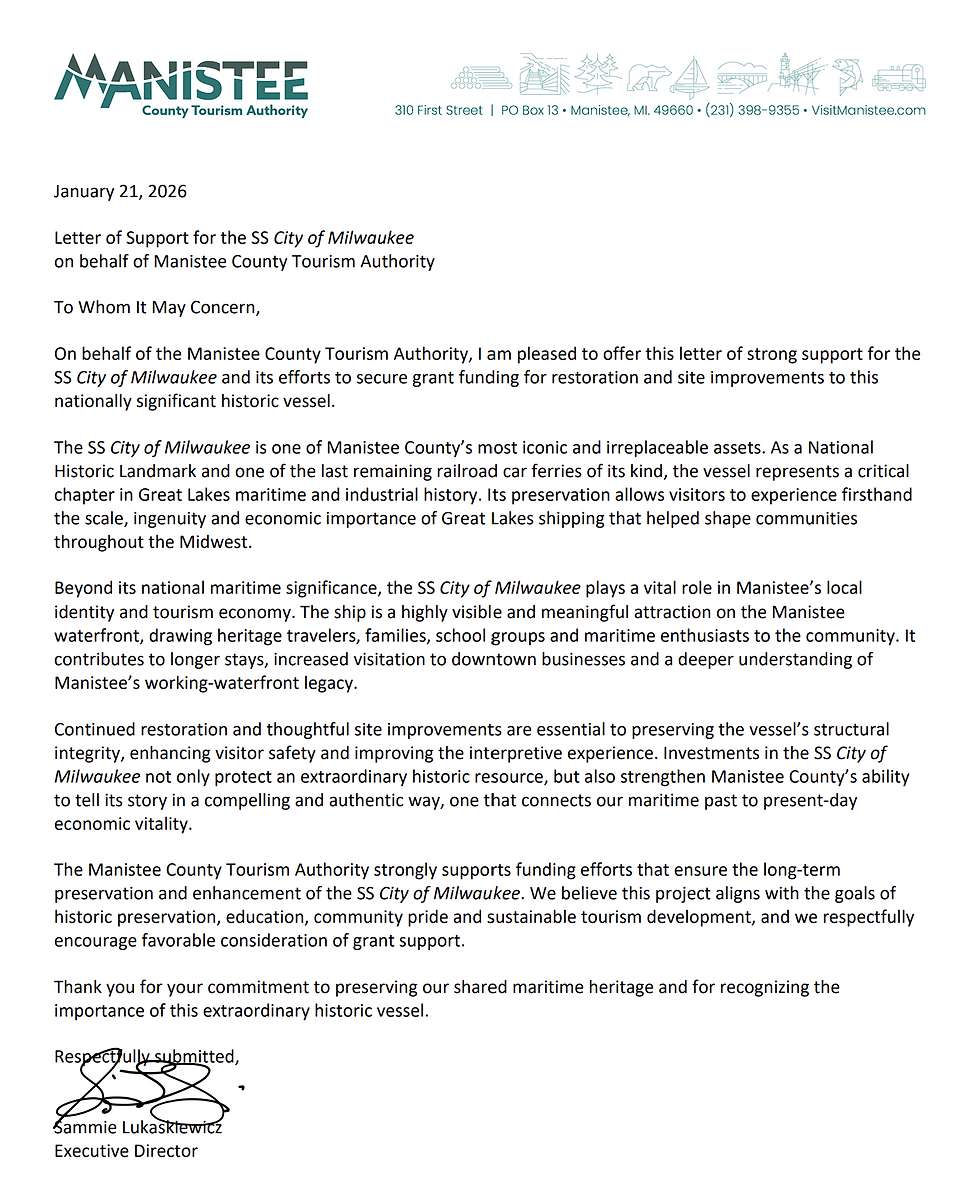
Letters of Support
We greatly appreciate all letters of support from public officials, donors, and supporters. They will help strengthen our funding requests by demonstrating support for the ship.


Marine Survey
Our updated Marine Survey, documenting the condition of the S.S. City of Milwaukee. Thank you to Bob Ojala of A3Pi Services, LLC, for providing the survey and donating all associated costs.

Other Files
Other files pertaining to our Dry Dock project.